
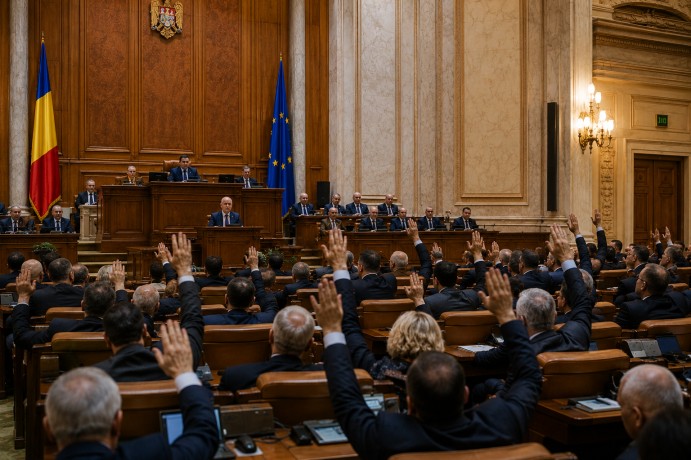
Romania remains without a government for the sixth week in a row as the political crisis intensifies. The country’s Parliament has rejected the government proposed by Prime Minister-designate Adrian Vestea. Despite his efforts to create a stable administration to end the ongoing political instability, Vestea fell short of the necessary support, securing only 189 out of the 233 votes required for approval.
In the wake of the failed vote, President Nicușor Dan is tasked with nominating another prime minister-designate. This individual will then have a 10-day window to form a new cabinet and seek the backing of Parliament. According to Romanian law, if two successive prime ministerial candidates do not receive parliamentary approval within a 60-day timeframe, Parliament can be dissolved, potentially leading to early elections.
The political stalemate has been exacerbated by deep divisions that have made forming a majority government nearly impossible. Analysts are now considering a minority government as the most plausible solution to break the deadlock. This political uncertainty coincides with significant economic challenges facing Romania, including a substantial budget deficit and the pressing need to secure European Union recovery funds.
The ongoing deadlock has raised concerns about Romania’s ability to address these economic issues efficiently. The necessity of forming a government that can navigate both the internal political landscape and external financial obligations is becoming increasingly evident. As the situation develops, all eyes are on President Dan’s next move and the potential for a resolution to this prolonged political impasse.